Programming
LeetCode Daily Problems Dashboard
Like many, I've used LeetCode religiously to sharpen my coding skills and master Data Structures & Algorithms. Lately, I've been as committed to maintaining my LeetCode daily streak as I have been to my Duolingo one! To keep myself motivated and track my progress, I built an automated Streamlit Dashboard that monitors my journey and provides deeper insights into my performance. Highlights include a backend powered by an AWS RDS MySQL database, a daily problem tracker, a predictive benchmark, and interactive Plotly visualizations. This has been a fun side project as I continue to level up my MLOps and Data Science skills while job hunting.
Application Tracker
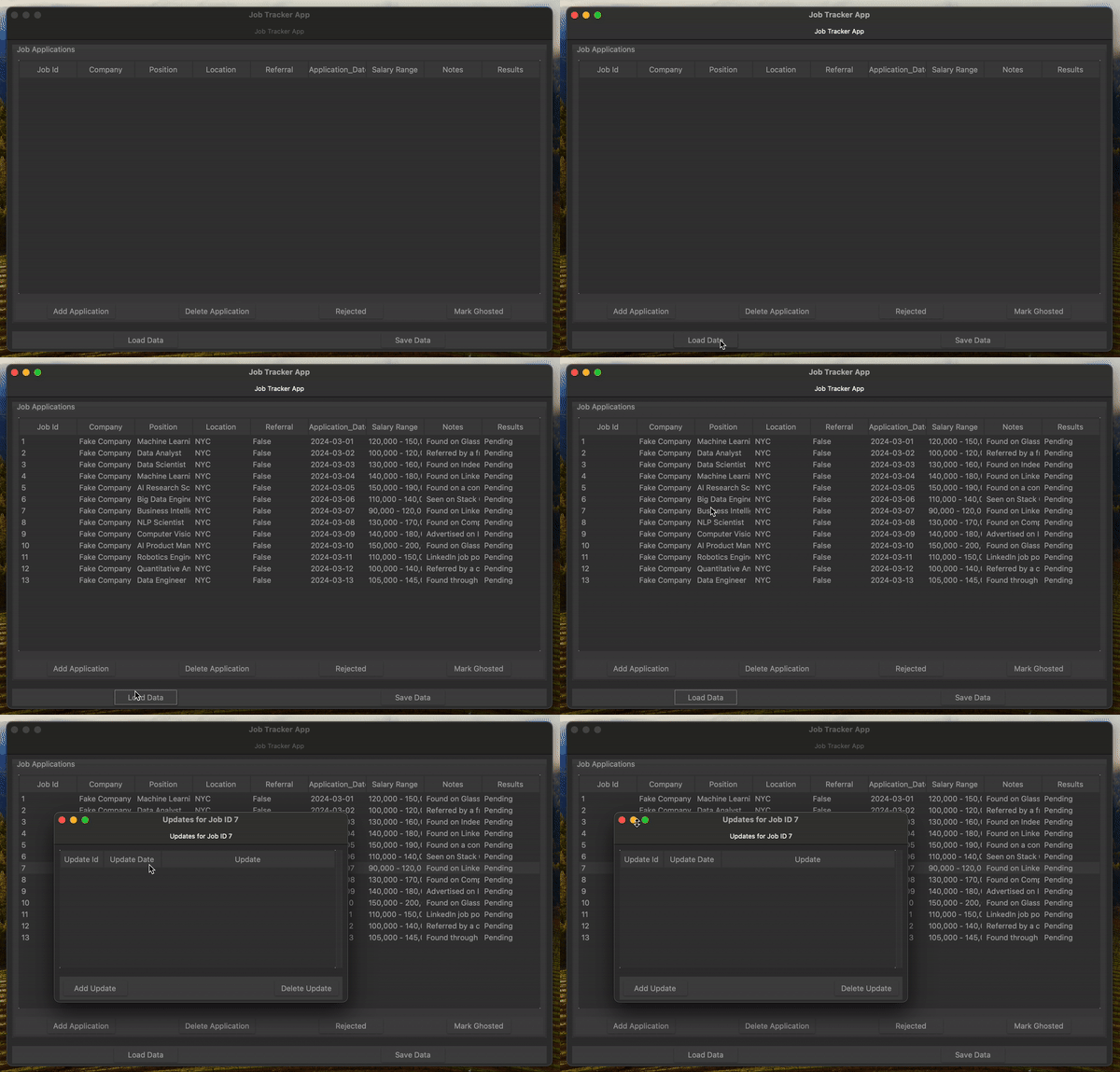
I wanted an organized and automated way to keep track of my job applications, so I developed a Python-based database with a graphical user interface (GUI) to record and manage applications. The system provides automated updates based on the status and progress of each application.
I gave it a GUI so my friends who are in the same position can use it as well. Happy hunting everyone.
Python Games
I enjoy games because their well-defined parameters and constraints create an ideal environment for practicing critical thinking and problem-solving. When I was teaching, I incorporated games into my lessons whenever possible. To enhance coding practice, I selected a few games and gave them a try. Check out my Python for the games I chose here..Greedy Pig Game
I first played the Greedy Pig Game in college. When I taught probability, I introduced it to my students and they got very competitive with it. The game is quite simple and can be played in groups of however many people.
Rules:
There are 5 rounds.
- A die is rolled. Whatever number appears on the die (except 1) is added to every person's score.
- Players can either choose to end their turn or keep rolling.
- If a rolled die ends up with 1, the round is over and everyone who is still in the round has their score for the round set to 0.
- Play 5 rounds and whoever has the highest cumulative score wins.
It's a simple and fun game so I chose to program this next. This was unaided and done individually.
Blackjack
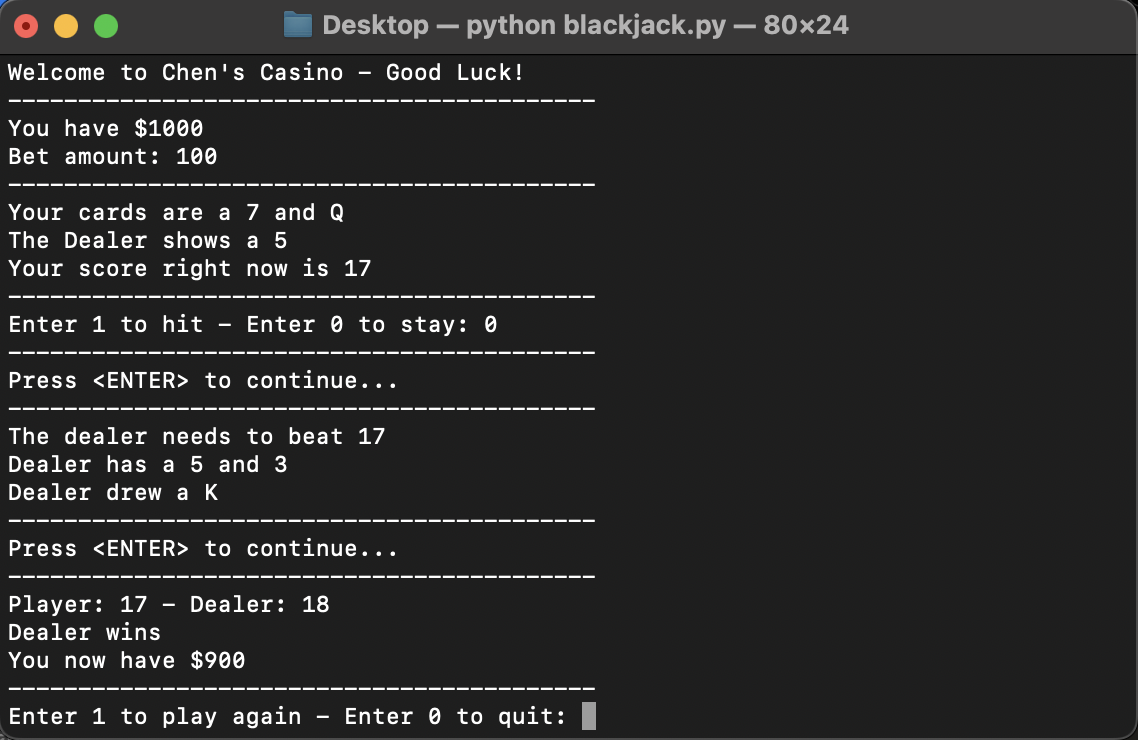
This is not a game I played with my students. Actually, I don't play blackjack but I decided to tackle a more complicated game. This was a lot of fun as I had to juggle many more moving pieces. After I implemented the basic aspects of Player Wallet, Calculating Score, and Dealing Cards, I added Insurance and Doubling Down.
High Low Red Black
The one piece of advice that I got repeatedly from all my more experience friends was: "Why are there global variables everywhere? Use a class." And that was my introduction to object oriented programing. I tried to create a Card and a Deck class.
I used this to make another simple probability game: High Low Red Black. The game is simple. Guess if the next card is higher, lower, red, or black. Get as many in a row right as you can.